Choosing a Carton Erector Machine in 2026 is not simply a capacity decision. It affects line speed, labor use, packaging accuracy, and maintenance demands. A machine rated for 20 cartons per minute may look suitable. However, frequent size changes can reveal serious limitations. Small flaps, dusty corrugated board, and uneven blanks may cause repeated stoppages. Real production conditions matter more than brochure figures.
This guide examines the practical factors behind a reliable purchase. It considers carton dimensions, board quality, forming speed, sealing methods, changeover time, and control systems. Operators should also check sensor placement, emergency stops, noise levels, cleaning access, and spare-part availability. A live factory trial can expose weaknesses that specifications hide. Ask the supplier to run your actual cartons, including the smallest and largest sizes. Record jams, adjustment time, glue performance, and recovery after a fault. Maintenance technicians and machine operators should join the evaluation. Their experience often reveals problems missed during management demonstrations.
Total cost deserves careful attention. A lower purchase price may bring higher downtime, difficult servicing, or expensive replacement parts. Supplier references, training support, warranty terms, and response times provide useful evidence of reliability. Still, no machine is perfect. Even a well-designed unit may struggle with poor carton blanks or changing production demands. That is why this article focuses on balanced decisions, practical testing, and measurable results. The best Carton Erector Machine is not always the fastest model. It is the one that performs consistently within your real operating environment. Measure twice. Then decide.
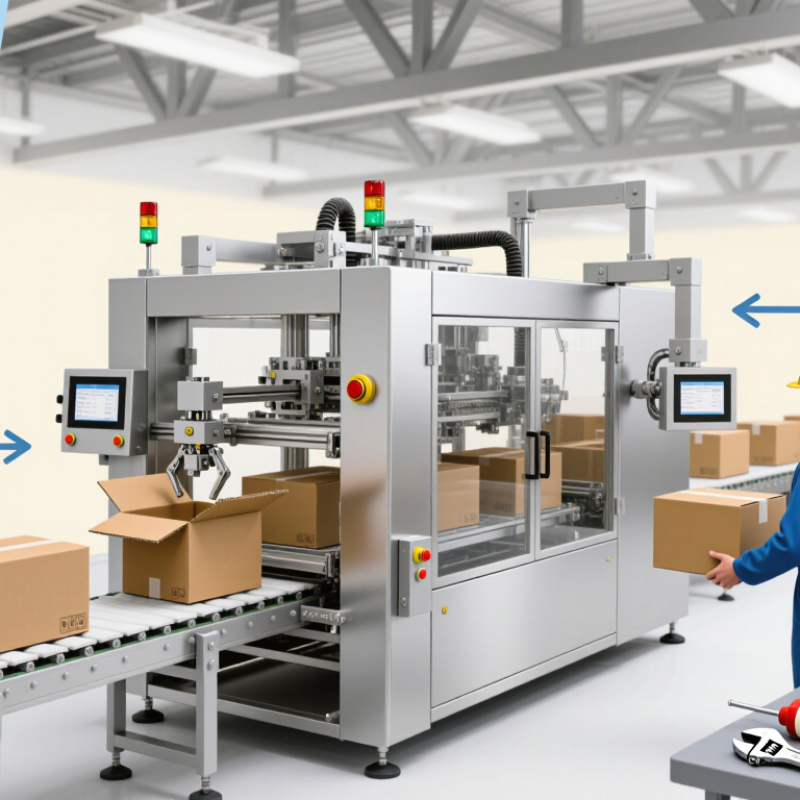
A carton erector machine automatically opens flat carton blanks, forms their panels, and seals the bottom. It replaces repetitive hand assembly with controlled, measurable movement.
The process begins in a magazine holding stacked blanks. A vacuum cup or mechanical gripper pulls one blank forward. Folding guides create the carton shape as belts or chains move it through the machine. Sensors check alignment, while a PLC coordinates timing and detects jams.
The bottom flaps then close and receive tape, adhesive, or another approved sealing method. Some machines erect cartons continuously, while others pause for filling. This difference affects speed, labor planning, and line balance. Small errors matter. Poorly adjusted guides can crease cartons or leave uneven corners.
Tips: Measure your carton range, board thickness, and required output before comparing machines. Request a live test using your actual blanks. Watch the changeover, not only the advertised speed. Ask how operators clean sensors, replace wear parts, and respond to misfeeds. A practical trial often reveals more than a specification sheet. Also check whether the machine records faults clearly. Unclear alarms waste production time. Leave room for future carton sizes, but do not pay for capacity your line cannot use. The best choice may be less impressive on paper. It should be stable, accessible, and easy to train operators on.
How to Choose a Carton Erector Machine in 2026?
Which Carton Erector Specifications Match Your Packaging Needs?
Choose specifications around your actual carton mix, not a brochure’s highest speed. PMMI’s 2024 State of the Industry report identifies labor availability and productivity as major automation drivers. Measure normal output during a complete shift. Record jams, changeovers, and rejected blanks. Peak speed is not output.
Carton size is the practical starting point. Check minimum and maximum length, width, and height. Confirm compatibility with your blank dimensions and board grades. A machine rated at 30 cartons per minute may slow with soft, warped, or recycled blanks. Smithers projects the global corrugated packaging market to grow from about 176.8 billion dollars in 2023 to 205.5 billion dollars by 2028. More formats may follow. Test your own cartons first. I would not trust specifications alone.
Tips: Keep 15–20% spare capacity for demand changes. Confirm tool-free changeover time, glue or tape compatibility, air consumption, noise, and cleaning access. Ask operators to review the layout. A compact machine saves floor space, but poor access creates daily frustration. Leave room for lighter board, recycled content, and future carton sizes. This part is easy to underestimate.
Choosing a carton erector in 2026 starts with measured performance, not the fastest number in a brochure. In plant trials, compare cartons per minute, stable output, and recovery after a jam. A machine rated at 30 cartons per minute may average 24 when blanks vary or operators refill the magazine. That difference matters during an eight-hour shift. Test your carton sizes, board grades, and adhesive requirements. Use your own blanks where possible. Real conditions reveal more.
Accuracy means square cartons, consistent flap positions, and reliable opening without crushed corners. Inspect at least 100 consecutive cartons, then record rejects and minor stops. One flawless sample proves little. Check changeover time, sensor response, and adjustment markings. Clear scales help operators repeat settings. My early comparisons focused too heavily on speed. That was a mistake.
Automation should match your staff and maintenance skills. Basic systems may require manual loading and frequent checks. Higher automation can control blank feeding, detect faults, and record production data. It can also increase software complexity and downtime risk. More automation is not automatically better. Ask for a factory test, maintenance schedule, spare-parts availability, and operator training details. Review safety functions carefully. A reliable machine is one your team can set correctly, inspect confidently, and repair without guesswork.
This reference comparison uses commonly specified operating ranges for carton erectors. Speed is measured in cartons per minute, accuracy represents the expected successful forming rate under stable conditions, and the automation score ranges from 1 (operator-dependent) to 5 (fully integrated and automatically monitored). Actual performance depends on carton size, board quality, adhesive or tape, and changeover requirements.
Choosing a carton erector in 2026 requires more than checking speed and carton size. Safety features should be verified during a live risk assessment, not only in a sales document. Look for guarded forming areas, safety-rated door interlocks, emergency stops, and clear lockout/tagout access. ISO 12100 and ISO 13849-1 provide useful frameworks for evaluating hazards and control reliability. The PMMI 2024 State of the Industry report valued U.S. packaging machinery shipments at about $11.3 billion in 2023, showing strong investment in automated equipment.
Maintenance details often decide whether that investment performs well. Choose a machine with tool-free access, visible lubrication points, guided changeover instructions, and fault messages that identify the failed sensor or actuator. A technician should reach the glue, tape, vacuum, and magazine areas without awkward climbing or exposed motion. Keep critical spare parts locally. That sounds obvious.
Integration deserves equal attention. Confirm communication options, such as industrial Ethernet, remote I/O, and compatible safety signals. The erector should exchange ready, fault, carton-low, and speed data with conveyors and downstream packaging equipment. Ask for documented cycle-time tests using your actual carton board, dimensions, and adhesive. PMMI’s report also identifies labor availability and automation needs as major investment drivers, but higher automation can create harder troubleshooting. A perfect interface on paper may still fail during a dusty night shift. Test recovery after a jam, not just normal operation.
| Category | Feature or Checkpoint | Recommended 2026 Selection Benchmark | Why It Matters | How to Verify Before Purchase | Priority |
|---|---|---|---|---|---|
| Safety | Fixed guards around moving mechanisms | All accessible nip points, chains, belts, forming arms, and drive components should be enclosed or otherwise safeguarded after a documented risk assessment. | Prevents contact with crushing, shearing, entanglement, and drawing-in hazards. | Request the machine risk assessment and inspect every operator and maintenance access point during a factory acceptance test. | Essential |
| Safety | Interlocked access doors | Guard doors should stop hazardous motion when opened; trapped-key or guard-locking arrangements may be needed where motion continues after power removal. | Reduces the possibility of entering a hazardous area while the machine is still moving. | Check safety-device response time, restart behavior, fault detection, and whether bypassing is prevented. | Essential |
| Safety | Emergency-stop system | Clearly visible, easily reachable emergency-stop devices at operator and material-loading locations, with manual reset and controlled restart. | Provides a rapid means of stopping hazardous motion during abnormal events. | Confirm emergency-stop locations, reset logic, stop category, and validation records against ISO 13850 principles. | Essential |
| Safety | Safety-control architecture | Safety functions designed and validated to the performance level required by the risk assessment, commonly using safety relays or safety PLCs. | Ensures that a single fault does not unexpectedly defeat a critical safety function. | Ask for the safety-function list, PL or SIL calculation, validation report, and proof-test procedure. Do not accept a generic rating without application evidence. | Essential |
| Safety | Safe setup and jog mode | Low-speed setup, hold-to-run controls, restricted access, and clear mode selection for format changes and troubleshooting. | Allows adjustment without relying on unsafe bypasses or uncontrolled motion. | Observe a complete changeover and verify that production mode cannot be selected with an open guard. | Essential |
| Safety | Electrical and pneumatic isolation | Lockable main disconnect, pneumatic dump valve, residual-pressure indication, and clearly labeled isolation points. | Supports safe cleaning, jam removal, maintenance, and stored-energy control. | Review the lockout/tagout procedure and verify that electrical, pneumatic, and mechanical stored energy can be controlled. | Essential |
| Maintenance | Tool-less access and adjustment | Hand-adjustable guides and quick-release access panels wherever possible, with scales or repeatable position indicators. | Shortens changeover time and reduces adjustment errors. | Time a representative carton-size changeover and record the number of tools, adjustments, and trial cartons required. | High |
| Maintenance | Condition monitoring and diagnostics | Fault codes, sensor-status display, motor or drive alarms, low-air-pressure detection, and production-stop history on the HMI. | Helps technicians locate faults faster and supports preventive maintenance. | Create common faults during testing and verify that the HMI identifies the affected device and corrective action. | High |
| Maintenance | Lubrication and inspection access | Accessible lubrication points, centralized grease fittings where practical, guarded inspection windows, and a written maintenance schedule. | Promotes consistent servicing of chains, bearings, cams, and other wear components. | Request lubrication type, quantity, interval, inspection criteria, and estimated service time for each task. | High |
| Maintenance | Wear-part replacement and spares | Documented replacement procedures for belts, chains, suction cups, sensors, knives, vacuum components, and forming tooling. | Improves uptime and reduces dependence on specialist service personnel. | Obtain a recommended spare-parts list, part identification method, lead-time commitment, and training plan. | High |
| Integration | Line-control interface | Clearly documented run, stop, permissive, ready, fault, carton-low, and downstream-blocked signals using the plant’s required hardwired or industrial-network interface. | Prevents accumulation, starvation, and unexpected restarts when connected to conveyors or packaging equipment. | Review the I/O list, network map, handshake sequence, and line-control cause-and-effect matrix before ordering. | Essential |
| Integration | Industrial communication compatibility | Support for the protocols already approved by the facility, with defined data tags and documented network-security settings. | Reduces gateway hardware, commissioning effort, and data-mapping errors. | Confirm protocol, revision, tag list, update rate, user permissions, remote-access controls, and ownership of the network configuration. | High |
| Integration | Recipe and format management | Password-protected recipes for carton dimensions, magazine settings, vacuum timing, flap-folding parameters, and line speed. | Improves repeatability and limits unauthorized parameter changes. | Test recipe creation, revision control, backup, restore, user levels, and change history using several carton formats. | High |
| Integration | Performance and OEE data | Accessible counts for erected cartons, good and rejected units, run time, stops, fault causes, speed, and availability events. | Makes recurring stoppages and performance losses measurable without relying only on manual records. | Compare the machine’s data definitions with the plant’s OEE standard and verify timestamp, reset, and downtime rules. | High |
| Integration | Upstream and downstream compatibility | Stable operation across the specified carton board, blank dimensions, conveyor height, product pitch, line speed, and accumulation conditions. | A machine that works alone may still cause jams or misfeeds in the complete packaging line. | Run representative cartons and line speeds during a site acceptance test, including empty magazine, blocked discharge, and restart conditions. | Essential |
| Documentation | Technical file and operator documentation | Current manuals, electrical and pneumatic schematics, spare-parts drawings, safety validation, software backup, and multilingual operating instructions. | Supports compliance, training, troubleshooting, and long-term maintainability. | Make document delivery, software access, training, and update responsibilities contractual acceptance criteria. | Essential |
| Compliance | Applicable standards and local requirements | Design and documentation aligned with applicable requirements such as ISO 12100, ISO 13849-1, ISO 13850, IEC 60204-1, and the regulations of the installation country. | Standards help establish a repeatable method for risk reduction, control-system safety, emergency stopping, and electrical safety. | Have the purchaser’s safety or compliance team review the declaration, risk assessment, drawings, and validation evidence before shipment. | Essential |
Note: Performance levels, safety circuits, inspection intervals, and communication interfaces must be selected for the specific machine, process, installation environment, and applicable local regulations. Supplier claims should be confirmed through documented risk assessment, validation records, and acceptance testing.
When evaluating a carton erector, look beyond the purchase price. Calculate total ownership cost over five to eight years. Include installation, tooling, electricity, compressed air, maintenance, spare parts, and operator training. A low-cost machine may become expensive after repeated jams or slow changeovers. Ask for measured output using your actual carton board, sizes, and closure method. Published speed can be optimistic.
Supplier quality matters as much as machine design. Request a factory acceptance test with your carton samples. Check changeover time, carton squareness, glue or tape consistency, and reject rates. Ask how quickly technicians respond and which parts are stored locally. Review warranty terms carefully. References from similar production lines are useful, but they are not perfect evidence. Your site conditions may differ.
Tips: Compare five-year cost, not only the quotation. Inspect the control cabinet and safety documentation. Confirm that operators can adjust guides without special tools. Ask for service records from comparable installations. Leave room for future carton sizes. This is often overlooked. Also, challenge the supplier’s assumptions about uptime. A spreadsheet can hide cleaning delays, unstable board quality, and short production runs. Choose a machine that remains practical during ordinary, imperfect shifts, not only during a successful demonstration.
Start with your normal carton mix, not the highest advertised speed. Measure output across a complete shift. Record jams, changeovers, and rejected blanks. Peak speed misleads.
Confirm minimum and maximum length, width, and height. Match these limits with your blank dimensions and board grades. Leave space for future carton sizes. Do not guess.
Soft, warped, or recycled blanks can reduce stable output. Magazine refilling and jam recovery also consume time. A machine rated for 30 cartons per minute may average 24. Test real blanks.
Keep roughly 15–20% spare capacity for demand changes. This cushion helps during larger orders or slower materials. Do not size the machine only for today’s average output. Future demand is uncertain.
Inspect at least 100 consecutive cartons during a trial. Check square shapes, flap positions, opening quality, and crushed corners. Record rejects and minor stops. One perfect carton proves little.
Use your own cartons, board grades, and adhesive requirements. Measure stable output, changeover time, sensor response, and jam recovery. Check whether operators can read adjustment markings easily. Small details matter.
No. Higher automation may detect faults and record production data. It can also add software complexity and downtime risks. Choose controls your staff can operate and maintain confidently. More automation is not automatically better.
Confirm tool-free changeover, glue or tape compatibility, air consumption, noise, and cleaning access. Ask operators to review the layout. A compact machine may save floor space but create poor daily access. I underestimated this before.
Choosing the right Carton Erector Machine in 2026 requires a clear understanding of your packaging process, carton sizes, production volume, and available floor space. These machines automatically open flat cartons, form them into shape, and seal or prepare them for filling, reducing manual labor and improving consistency. When comparing models, review their carton-size range, forming method, operating speed, accuracy, changeover time, and automation level to ensure they match both current and future production needs.
Safety, maintenance, and integration are equally important. Look for accessible components, reliable protection systems, clear controls, easy cleaning, and compatibility with conveyors, filling equipment, and control systems. Total value should include the purchase price, installation, training, energy use, spare parts, maintenance requirements, and expected service life. Evaluating suppliers by technical support, customization capabilities, delivery reliability, and after-sales service can help you select a dependable machine that improves efficiency and supports long-term packaging growth.

Huisu